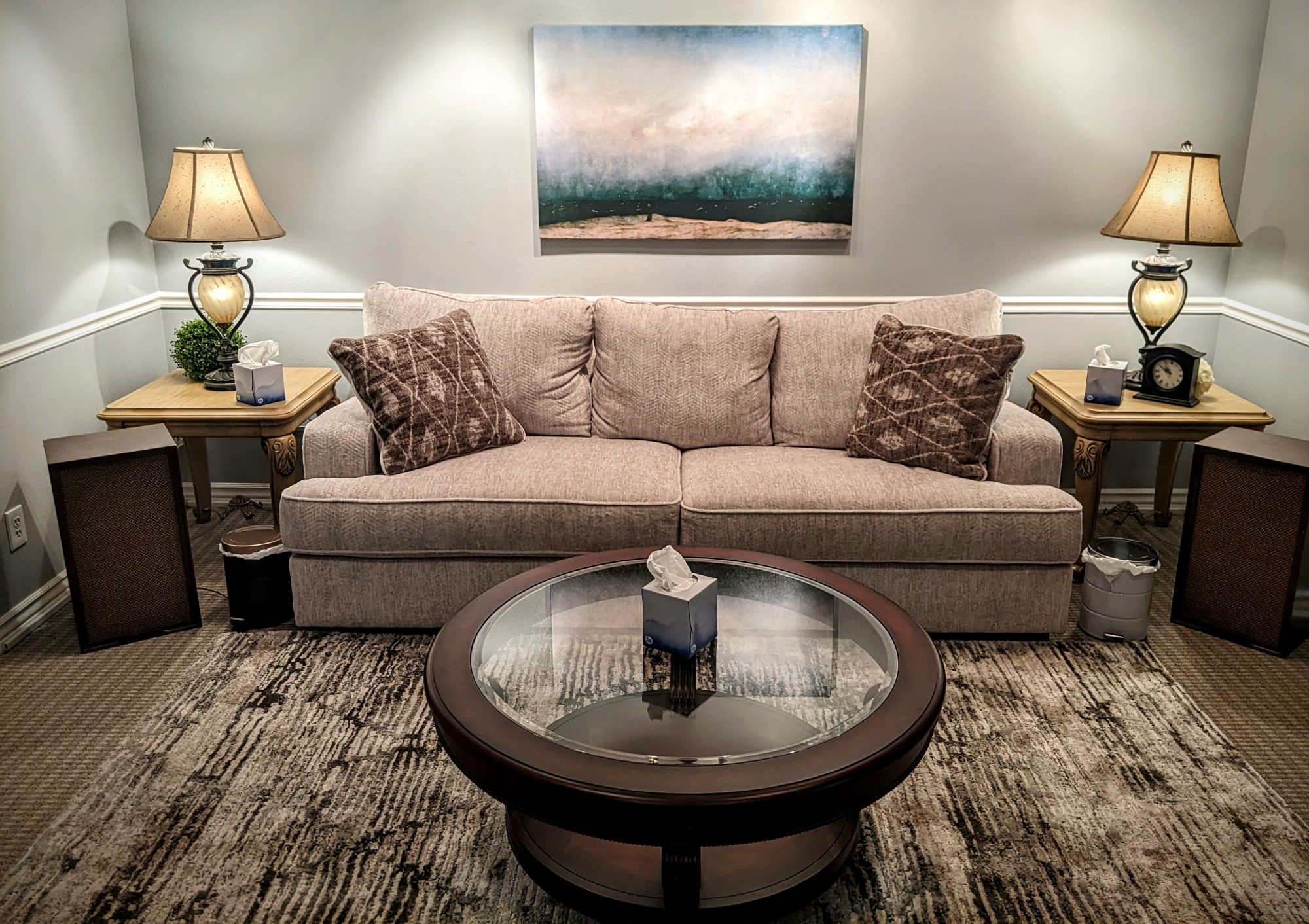
Are you a passionate therapist looking to enhance your skills and connect with a community of supportive professionals?
We invite you to join the Peer-Reviewed Counselor Group—a unique, therapist-led community where the sharing and review of recorded therapy sessions are at the heart of our collaboration, learning, and professional growth.
Our goal is to make this process as easy as possible for members. If you have questions about how to ask clients for consent, ethical documentation needed, effective recording equipment, confidentiality, and etc. look below and reach out to Tyler with any further questions.
🌟 Why Join Us?:
Break the Isolation: Be part of a community that understands your challenges and celebrates your successes.
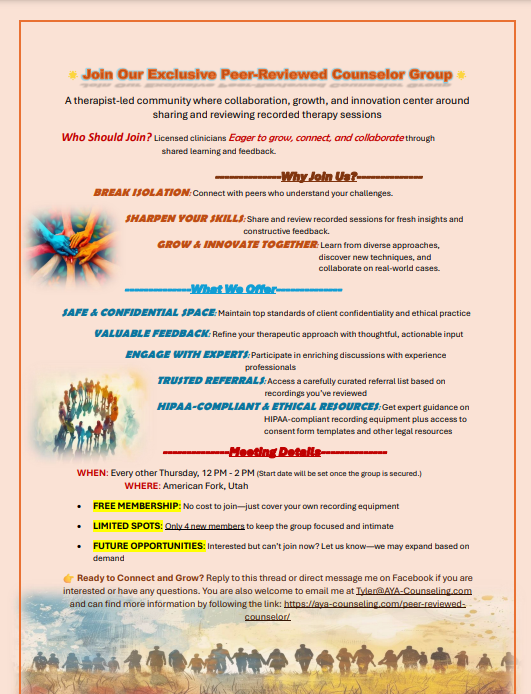
Sharpen Your Skills: Share and review recorded sessions, gaining fresh insights and constructive feedback from your peers.
Grow & Innovate Together: Learn from diverse approaches, discover new techniques, and collaborate on real-world cases to enrich your practice.
Research
1. Current and replicated longitudinal research indicates that mental health counselors on average do not increase but actually decrease in their effectiveness over time. The same studies shows that there is in an increase in counselor arrogance over time.
– Goldberg, S.B., Rousmaniere, T., Miller, S. D., Whipple, J., Nielsen, S. L., Hoyt, W. T., & Wampold, B. E. (2016). Do psychochotherapists improve with time and experience? A longitudinal analysis of outcomes in clinical setting. Journal of Counseling Psychology, 63(1), 1-11, https://doi.org/10.1037/cou0000131
– Germer, S., Weyrich, V., Brascher, A., Mutze, K., & Witthoft, M. (2022). Does practice really make perfect? A longitudinal analysis of the relationship between therapist experience and therapy outcome: A replication of Goldberg, Rousmaniere, et al. Journal of Counseling Psychology, 69(5), 745-754, https://doi.org/10.1037/cou0000608
2. 57% of individuals who graduate from a grad program with a counseling degree don’t go on to get licensed and discontinue work.
Study finds that financial concerns and lack of support as partial culprits
– Motivo_Whitepaper by Rachel McCrickard, LMFT https://motivohealth.com/about
You can request this study through their website
3. 45% of Counselors report experiencing high stress and burnout – https://www.apa.org/monitor/2023/04/psychologists-covid-burnout
Various studies show a burnout rate between 21%-67% throughout the years with increases to this during Covid)
4. Collaborative groups are not typical with mental health clinicians which indicates a strong isolative tendency in our field
All of the above point to a toxicity in our culture (therapist culture). We aren’t bringing new clinicians in, we’re burning out at high rates, and we aren’t getting better with time. What’s worse, we aren’t good at advocating for ourselves and preventing our own isolation, contrary to the guidance we provide to our clients. No one really knows our work with the exception of the client in the room. We can talk about it with our colleagues, but that’s a biased narrative that is limited in it’s ability to teach. I believe this group will offer participants as well as myself a better ability to grow in the profession instead of burning out.
🌟 Who Should Join?:
This invitation is for fully licensed clinicians who are eager to grow, connect, and collaborate. If you’re committed to improving your practice through shared learning and feedback, this group is for you!
🌟 What We Offer:
Ethical Resources: Receive guidance on recording equipment, along with consent form templates and resources for Protected Health Information (PHI).
Valuable Feedback: Receive actionable, thoughtful feedback that helps you refine your therapeutic approach.
Trusted Referral System: Develop an authentic referral list, based on recordings you’ve reviewed.
🌟 Meeting Details:
When: Every other Thursday, 12pm – 2pm (The official start date will be identified once the group is secured.)
Where: 479 W 50 N, American Fork, UT 84003
🌟 Important Details:
Free: There’s no cost to join; just cover your own recording equipment.
Exclusive Spots: We’re keeping the group small—just 4 new members (Total Group of 6) to maintain an intimate and focused environment.
Can’t Join Now? Let us know if you’re interested in future opportunities—we may expand based on demand.
🌟 Why is Tyler Hosting this Group
I’ve been working in the field for the past 7 years and have recognized how isolating this career can be. While contracting in a group practice and running my own private practice over the last year, I became interested in recording sessions with clients and sharing with my colleagues in an effort to learn more about the work they were doing and in an effort to share my own work. I was able to, with the consent of my clients, record sessions on a secure device, share selections of sessions with my licensed colleagues, and receive valuable feedback on my work. The group unfortunately did not mature and I have since left the group practice and am seeking other like minded individuals who are interested in developing this and possibly other future groups.
🌟 What is the Structure of the Group
The group will meet every other week and will comprise of 6 licensed therapists (including the Host). Each meeting, 3 of the 6 therapists will utilize 30 minute intervals in which they will describe their client, show video footage of a session with their client, and welcome feedback and/or provide insight and techniques to other members of the group. Presenters will alternate each meeting to provide effective demonstration or gain valuable feedback/consultation from their fellow clinicians.
Tyler (Host) will provide organization/structure through a humanistic approach which will serve to invite members to share and respond/collaborate. Tyler will initially model during early sessions how sharing and receiving feedback can be accomplished and will alternate presenting in later sessions once group is fully operational, acting as a member of the group while still providing for organization of the group.
🌟 How do Clients Feel About Being Recorded and Therapist Collaboration?:
Note: All information from clients is anecdotal
Questions asked to clients:
1. Are you interested in having your sessions recorded for the sake of clinical collaboration?
Of my 30 clients I work with weekly, 14 shared direct interest in having their sessions recorded and shared with other practitioners. When asked why they were directly interested, individual replies included: “I would rather have 6 clinicians reviewing my work in your office and identifying ways you can assist me”; “I believe strongly in collaboration and it’s benefits in all fields”; “Why wouldn’t I want you to continue learning how to become a better counselor. That directly helps me”.
Of my 30 clients, 13 indicated that they wouldn’t mind being recorded for the sake for collaboration with colleagues but did not indicate a direct interest.
Of my 30 clients, 3 clients reported not wanting to be recorded
Note – I reported the purpose of the collaboration group to all clients and the extent that each recording made would be stored, shared, and deleted for ethical purposes. I additionally mentioned to each of my clients my own feelings about being a client and having my sessions recorded, reporting that I would myself not volunteer for this provided I value my privacy. Each response indicated above was reported following this information provided. No incentive was provided to clients for recording sessions.
2. If you needed to find another therapist in the future, would you be more inclined to search for a therapist you know collaborates with other clinicians regularly over shared recorded sessions?
28 out of 30 clients reported that this would be valuable to them when looking for another therapist. 2 out of 30 clients indicated: “I don’t know that I would be interested enough to try to find this” and “I don’t think it would really impact me”.
🌟 What Resources has Tyler Found While Developing This Group
- Utah DOPL indicates that a consent form is required for clients who are consenting to the practice – Ask Tyler for example of this form if interested
- When starting a session, I ask for consent from the client before and directly after starting recording and ask the client to confirm at the beginning of the recording that they consent to the recording.
- HIPPA guidelines indicate that Protected Health Information (PHI)/Recordings must be stored on an encrypted device and deleted when no longer necessary. I recommend deleting recordings that are more than a month old.
- I encourage not recording on devices that aren’t themselves secured or encrypted
- I encourage avoiding transferring files across platforms
- I encourage deleting all files that are more than a month old
- I encourage clinicians no to record using online software due to PHI being stored. Avoiding recording on online software/apps will help to protect clients from having information/recorded sessions hacked, stolen, or subpoenaed
- Equipment for recording and storage and maintaining confidentiality
- Ask Tyler for further details on this.
Join Our Free Peer-Reviewed Counselor Group: Let’s Elevate our Practice Together!
👉 Ready to Connect and Grow? Contact me via email at tyler@aya-counseling.com or through phone at (801)686-8165
 As You Are Counseling